When success began to turn into a problem
The growth of trade also brought tensions. As demand increased, the price of Canary wine rose and English merchants looked for ways to control the business and improve their margins.
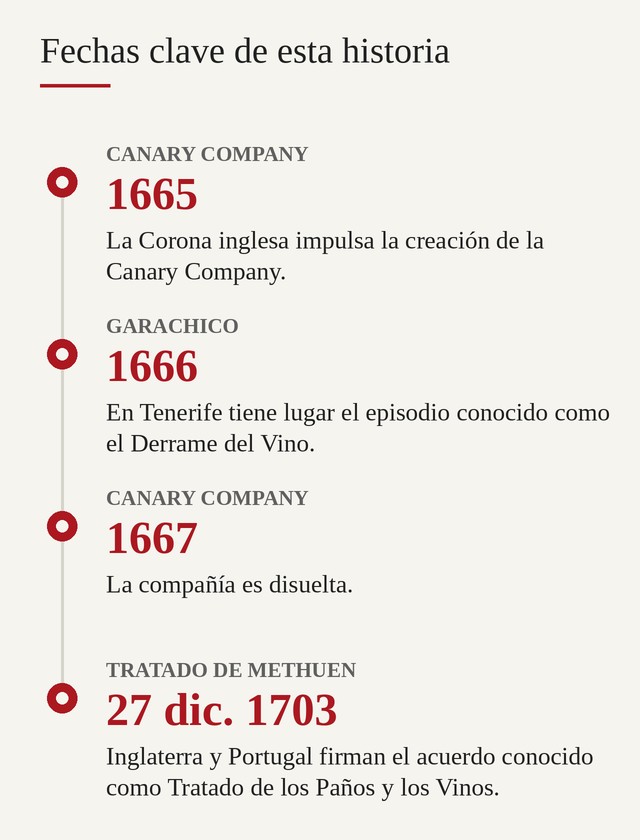
In 1665, the English Crown promoted the creation of the so-called Canary Company, a privileged company that aimed to control trade with the islands and to buy wines on terms favourable to English interests.
The initiative met with deep rejection from many Canary producers and merchants. The attempt to impose more advantageous trading conditions for the company threatened the growers' profits and their freedom to sell their wines.
The tension reached one of its most dramatic moments in Garachico, in Tenerife, in 1666. The trade conflict and the producers' resistance led to the events known as the Derrame del Vino (the Wine Spill), associated with the destruction of wine in protest against the conditions imposed on trade.
The company was dissolved in 1667, but the episode left a deep mark. Trade relations had deteriorated and Canary wine was beginning to face an increasingly difficult situation.
Added to this conflict were the restrictions of English maritime trade, the rivalries between European powers and the dependence of Canary producers on foreign markets and merchants. The splendour of Canary wine rested, to a large extent, on trade networks that the islands did not fully control.
The Methuen Treaty: a new piece on the trading board
If the 17th century had shown the fragility of Canary trade, the beginning of the 18th brought a new configuration of European economic relations.
On 27 December 1703, England and Portugal signed what is known as the Methuen Treaty, also called the Port Wine Treaty. The agreement established reciprocal trade advantages: Portugal eased the entry of English woollen cloth, while England granted Portuguese wines favourable tariff treatment compared with French wines.
The treaty wasn't specifically designed to harm the Canary Islands, but it helped strengthen Portugal's position in the British market. Portuguese wines, including those that would later become famous under the name of Port, benefited from a favourable trading framework that boosted their export opportunities.
To understand its importance, we have to look beyond the agreement itself. Competition between wine regions didn't depend only on quality or consumer preferences: it was also shaped by taxes, political alliances, sea routes and access to markets.
Canary wines had already suffered serious difficulties during the second half of the 17th century. The trade crisis, the conflicts with English merchants and the restrictions on trade routes had weakened their position. Methuen came later, in a context in which relations between England and Portugal were growing closer and Portuguese wines were gaining competitive advantages.
The Methuen Treaty doesn't explain the decline of Canary Sack on its own, but it helps us understand the new international scene in which Canary wines had to compete. Diplomatic decisions taken thousands of kilometres from the vineyards could have direct consequences for the islands' producers.
The history of Canary wine is also the story of how the great European powers used trade to defend their economic interests.
From commercial splendour to historical legacy
During the 16th and 17th centuries, Canary wines had achieved a privileged position in certain European markets. However, the combination of political conflicts, trade restrictions, changing tastes and international competition gradually eroded that position.
There was no single date on which Canary wine lost all its importance. It was a gradual process, with different causes and consequences, which affected the producing areas and their merchants unevenly.
The story of Canary Sack reminds us that even the most prestigious wines can be exposed to changes that go far beyond the vineyard and the winery.
But the decline of a commercial era didn't mean the disappearance of Canary wine culture. The accumulated knowledge, the varieties grown and the adaptation to the islands' particular conditions remained part of the archipelago's agricultural heritage.
A story that deserves to return to the glass
Today, when we uncork a Canary wine, we're not always aware of the historical depth behind it.
The archipelago's viticulture is the result of centuries of adaptation, exchange and knowledge. Its varieties, its volcanic landscapes and its ways of growing vines make up a unique heritage that deserves to be known and valued.
The story of Canary Sack reminds us that the Canary Islands were not just a stopover on the Atlantic routes. They were also a land producing wines capable of capturing the interest of merchants, travellers and writers in some of Europe's main markets.
As a sommelier, I believe that knowing this history enriches the way we approach wine. Each bottle holds aromas and flavours, but it also keeps the memory of those who worked the land, made the wine and carried it, centuries ago, far beyond our shores.
Canary wine has a past, a present and a future. And knowing its history is another way of enjoying it.
Iván Monreal Somm. Culture, history and passion for wine.
If you like wine with a story, discover the themed tastings of the Wine Club, the training for hospitality or write to me to organise a private experience.
Back to the blog